
There is nobody here, and that was the point. I have been away for long enough that the absence of human voices no longer feels unusual; there are no aircraft passing overhead, no distant traffic, no notifications demanding my attention and no town somewhere beyond the horizon that I might eventually have to return to. There is no road, no radio chatter and no civilisation waiting for me to participate in it. Instead there is the wind moving across the mesa, the occasional sound of wildlife far below and, from time to time, the almost imperceptible movement of one of the machines going about its work.
I have come back to the mesa.
From above, it looks almost perfectly circular, roughly 1.8 kilometres across and rising about 250 metres above the surrounding plain. Its sides are mostly sheer, dropping away into a landscape of smaller mesas, open ground and distant cliffs, so that from the air the whole thing has the appearance of an island surrounded by an ocean of land. This is not the Colorado Plateau I knew, although the resemblance is deliberate. This is the late Oligocene, roughly twenty-five million years before my original time, and there are no humans here. There will not be any for a very long time.
That was important to me when I chose the place.
I did not come here to colonise another world or to establish some grand experiment in human settlement. I came here because I wanted somewhere that was mine, somewhere I could live without having to participate in the endless machinery of human society. I wanted somewhere quiet enough that I could hear myself think, remote enough that I would never have to wonder whether somebody was going to arrive at the door, and self-sufficient enough that I would not eventually have to recreate the society I had left behind simply to keep myself alive.
So I built a place where I do not need anyone else.
The Mesa
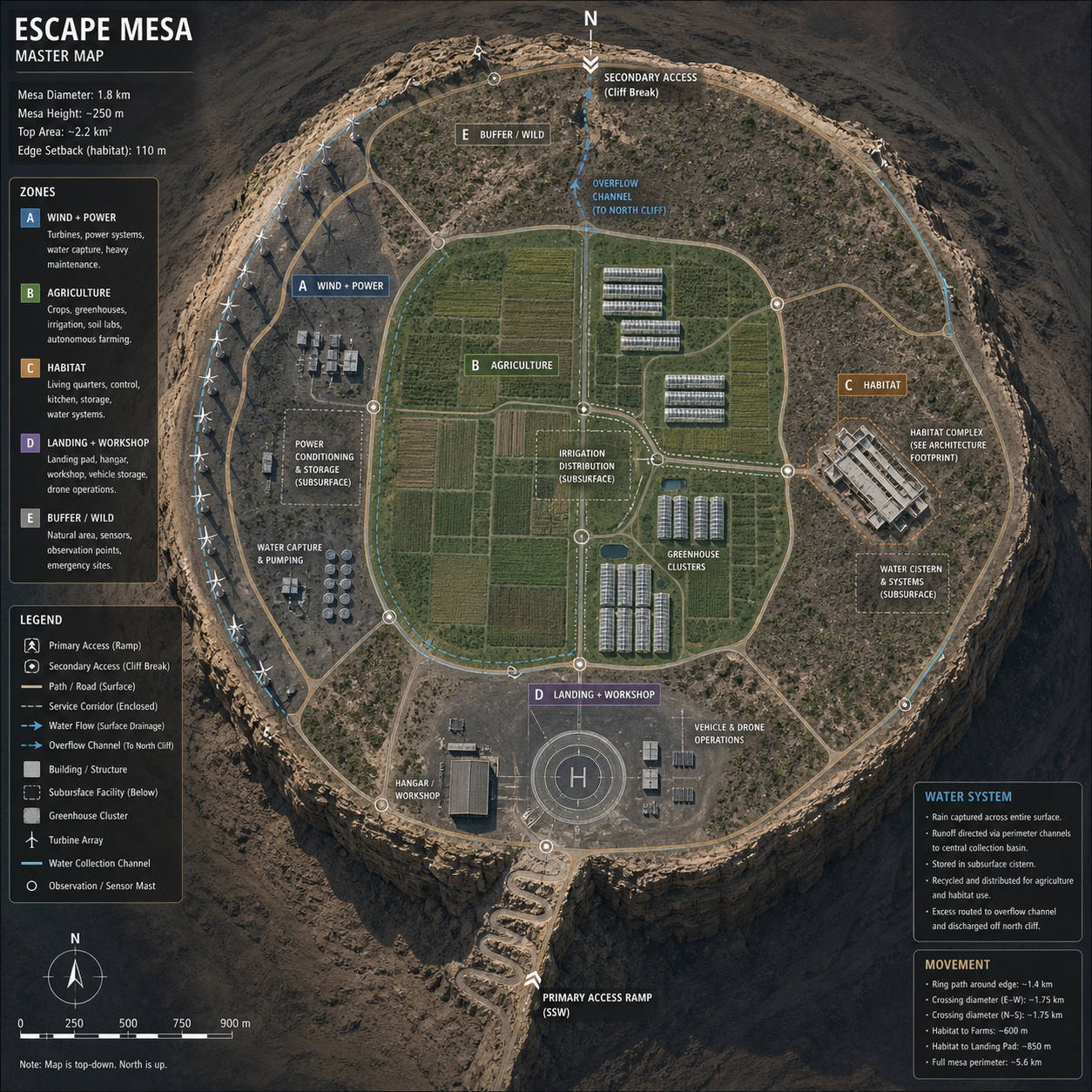
The habitat occupies only a small fraction of the mesa, while most of the surface has deliberately been left alone. I wanted the place to feel as though I had arrived here rather than conquered it, and that meant resisting the temptation to cover every available piece of ground with something useful. The western side is given over to energy production and the infrastructure that supports it, with the wind turbines set back from the cliffs and the associated power, storage and maintenance systems concentrated along that side of the mesa. The centre is agricultural, containing open growing areas, controlled-environment greenhouses and hydroponic systems, while the southern sector contains the landing pad, workshop and hangar. The eastern side, slightly raised and protected from the prevailing winds, is where I live.
At the northern edge there is almost nothing, and that is intentional. The landscape is allowed to continue uninterrupted apart from sensors, observation equipment and a carefully engineered drainage route that carries excess water towards the natural break in the cliffs. During heavy rain, water that the collection system cannot use immediately eventually reaches the northern edge and spills over the cliff, creating a temporary waterfall that can be seen from the habitat. Most of the time, however, the water is doing its work somewhere underground, moving through the collection, storage, treatment and recycling system without requiring any attention from me.
There are only two practical ways onto the mesa. The primary access is a reinforced natural ramp on the south-southwestern side, wide enough for utility machines and emergency vehicles, although there is very little reason for anything to use it on a normal day. The second is a narrow natural break in the northern cliffs, which serves mainly as an emergency route and as part of the water-management system. Everywhere else the mesa simply ends in cliffs, and I have deliberately kept it that way because there is something reassuring about knowing that the boundaries of the place are determined by the landscape rather than by fences or walls.
The paths across the surface follow the same principle. A ring route runs just inside the cliff edge, providing access for maintenance and inspection machines, while radial routes connect the living area with the agricultural zone, workshop and landing area. Most of the less visible movement takes place below ground, through service tunnels carrying power, water, data and mechanical systems between the different parts of the mesa.
A House Designed for One Person
The habitat is not really a house in the conventional sense. It is better understood as a small autonomous system in which one human happens to live, because almost everything required to keep me alive has been designed into the place from the beginning. There are no unnecessary rooms and no guest accommodation, because there is nobody to accommodate; there is no dining room designed for twelve people, no collection of spare bedrooms and no grand entrance intended to impress visitors who will never arrive. Every square metre exists because it performs a useful function, contributes to the efficiency or resilience of the system, or simply makes living here more pleasant.
The main living complex sits on the eastern side of the mesa, set well back from the cliff and arranged along a long, low axis running roughly northeast to southwest. It is partially embedded into the ground, with the western side forming a substantial protective mass against the prevailing weather while the eastern side opens towards the landscape. From the outside it is deliberately understated, almost disappearing into the mesa rather than announcing itself from a distance. There are no towers and no unnecessary structures rising above the surrounding terrain; the only things that really break the horizontal character of the place are the wind turbines on the western rim and the occasional movement of a drone above the agricultural area.
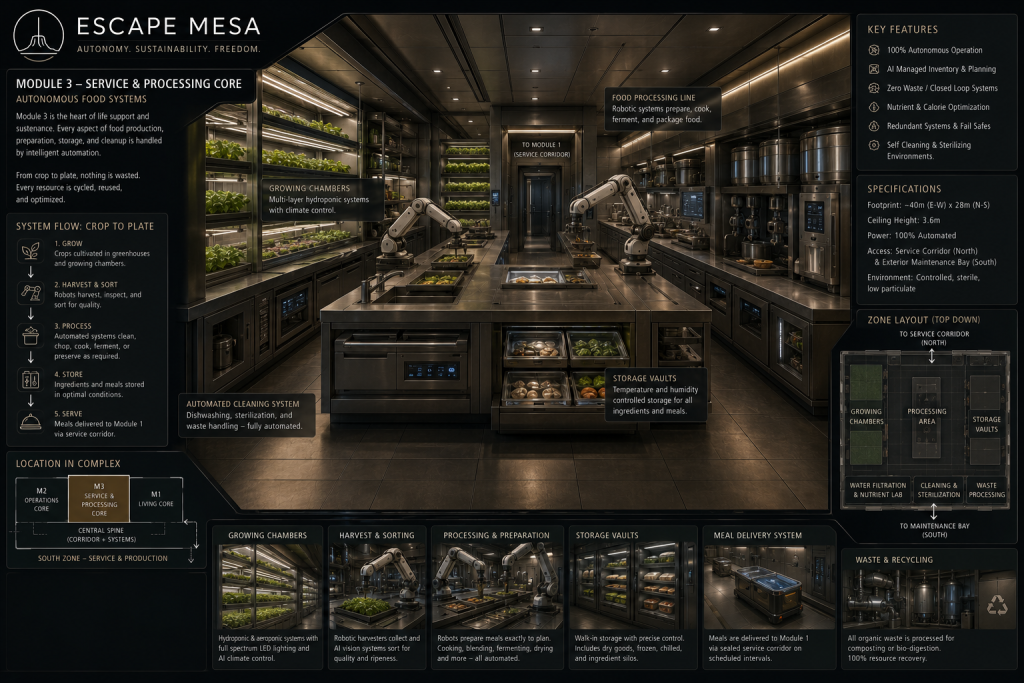
The building is divided into three connected volumes. The easternmost module is the living core, containing the main living and sleeping spaces, the observation area and the terrace facing the landscape. Behind it is the operations spine, where the computing, communications, environmental controls and monitoring systems are concentrated. The western service block handles food processing, storage, water interfaces and other practical functions, with much of its volume buried into the ground.
Inside, the arrangement becomes progressively more open as I move from the service side towards the view. The western part contains storage, utilities and access, the central section provides circulation and working spaces, and the eastern end opens into the main living area, where large areas of glazing look across the landscape. The building is partly split-level, with a mezzanine occupying part of the quieter rear section rather than extending across the glazed front, so that the main room retains its sense of height and openness.
One of the things I like most about the habitat is how little of its machinery I actually hear. The systems are everywhere, operating continuously behind walls, beneath floors and in the service areas, but the further I move towards the living spaces, the quieter the building becomes. The machinery is working constantly; it simply doesn’t need to make its work my problem.
The Living Core
The eastern end of the habitat is where I spend most of my time, partly because it is comfortable and partly because the view is difficult to ignore. The main living space faces east and northeast across the surrounding landscape, with the kitchen occupying a relatively small area because there is no need for a conventional domestic kitchen to carry out work that is already handled elsewhere in the system. I can prepare something myself when I want to, but most of the processing, storage and preservation of food takes place in the service block rather than in the room where I live.
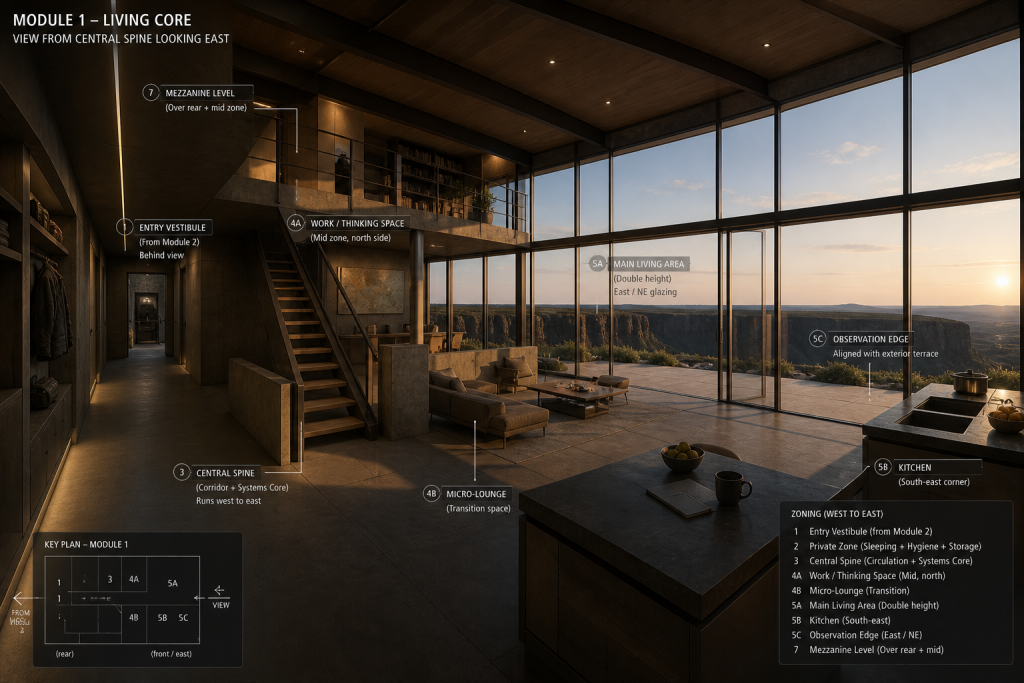
The seating area is positioned close enough to the glazing that I can look out across the landscape without making any particular effort to do so, and the architecture is deliberately quiet around it. There are no displays constantly demanding attention and no elaborate control panels scattered around the room. Most of the technology disappears into the building until I actually need it, at which point the information or controls I want can appear on one of the surfaces or displays.
The terrace extends along much of the eastern face of the building, giving me somewhere to sit outside without having to leave the immediate shelter of the habitat. It is high enough to give an uninterrupted view across the surrounding country, but far enough from the cliff edge that it never feels precarious. From there, the landscape changes dramatically with the weather. On clear mornings I can see for an enormous distance, while storms can arrive across the plain and transform the view within minutes.
The study occupies part of the central section and is probably the space I use most. One wall is a library, although most of the books are digital rather than physical, while the computing and media systems provide access to the much larger collection stored throughout the habitat. There is a large screen for films and television, an immersive audio system, games, research tools, simulation software and everything else required to make the digital library useful rather than merely impressive.
The important part is that none of it depends on a network outside the mesa. I brought the network with me.
Books, scientific papers, manuals, films, music, games, reference material, maps, software, technical documentation and a considerable amount of completely unnecessary entertainment are stored locally, with important information duplicated across independent storage systems. The machines continually check the data for corruption and maintain redundant copies, while the more critical systems have their own isolated backups. I can spend an afternoon reading about ancient history while sitting twenty-five million years before the first humans appeared, or spend an evening watching a film made millions of years after the landscape outside my window existed.
There is something satisfying about that contradiction.
The Study
The study isn’t really an office in the sense that I would once have understood an office. There is no meeting table, no filing cabinet and no need for a desk large enough to accommodate several people, because there is nobody here to meet and almost everything I need to work with exists digitally. The main workstation gives me access to the entire local knowledge base, while the surrounding systems handle research, simulation, navigation, media and communications within the habitat.
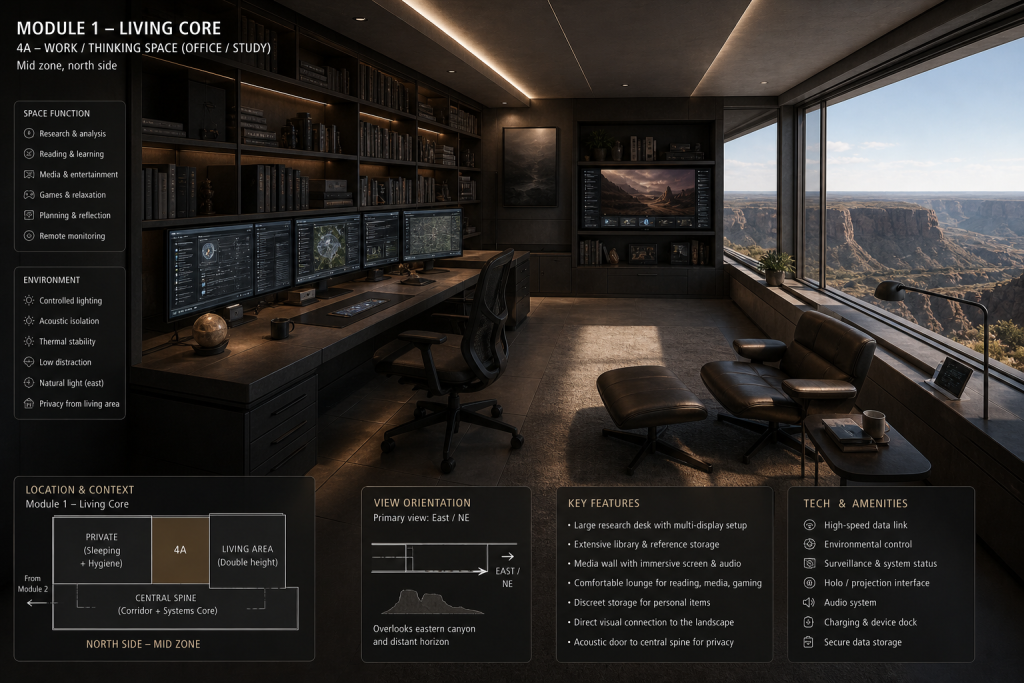
The physical books are there because I like books, and the media system is there because I like films, music and games. There is no contradiction between wanting to escape civilisation and wanting to take a very large portion of its accumulated knowledge and entertainment with me. In fact, having that material around me makes the isolation considerably more interesting, because I can move between the world I left behind and the world outside the window simply by changing what I am reading or watching.
The room is deliberately comfortable rather than clinical. It is somewhere to think, read, watch something, play a game or simply sit for a while and look out across the landscape. The main window faces east and northeast, towards the cliffs and the enormous expanse beyond them, and from the chair I can see the landscape extending towards the horizon without encountering a single trace of another human being.
There is also something useful about having a room where I can concentrate without interruption. In my old life, even solitude was rarely complete; there was always a device, a message, a meeting, a delivery or some other small demand waiting somewhere in the background. Here, if I want to spend six hours reading about something obscure, I can do it without anybody wondering where I am.
Sleep
The sleeping area is deliberately different from the rest of the habitat because there is no reason for a bedroom to compete with the spectacular view that is available everywhere else. It is darker, quieter and more enclosed, positioned towards the protected western side of the living module and separated from the main living area by the central spine of the building.
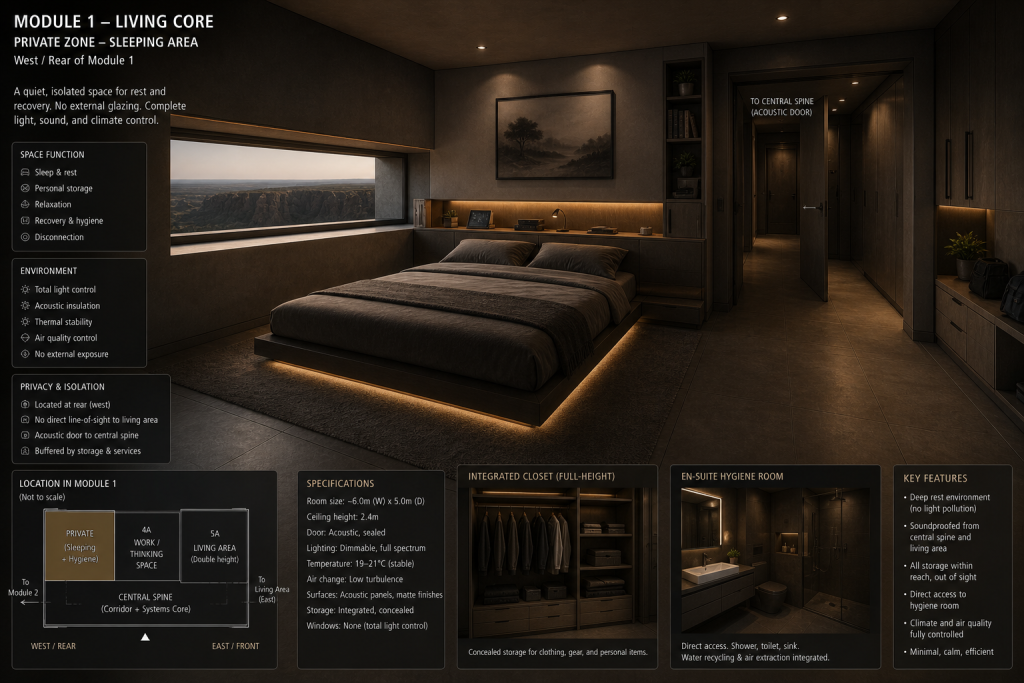
Temperature, ventilation, lighting and sound are all controlled automatically, with the system adjusting itself according to the time of day and my normal sleeping pattern. Fresh filtered air enters through the protected rear of the building and moves gradually through the living spaces, while the environmental system continually monitors temperature, humidity, air quality and carbon dioxide levels.
The bed is comfortable because there is no reason for it not to be, while everything else has been kept relatively simple. There is storage, a small private hygiene area and the things I actually use, but there is no attempt to turn the bedroom into another technological control centre. When I close the door, the rest of the mesa disappears, and for a few hours the fact that I am twenty-five million years from home becomes almost irrelevant.
Water
Water is the system I pay the most attention to, because almost everything else can be made redundant more easily than water can. The mesa receives rainfall, and almost every suitable surface is part of the collection system. The roofs collect it, the greenhouses collect it and engineered surfaces are shaped so that runoff is directed into controlled channels rather than simply disappearing over the cliffs.
The main cisterns are buried beneath the boundary between the habitat and agricultural areas, where they are protected from temperature extremes and physical damage. Rain is the primary input, while recycling provides the second. The system is deliberately designed around conservation rather than abundance, because although the mesa receives enough rainfall to make the arrangement practical, there is no reason to assume that every season will be equally generous.
Water from showers, sinks and other greywater systems is cleaned and returned to the usable-water cycle. Wastewater is treated, nutrients are recovered where practical, and only the fraction that cannot reasonably be recovered is removed from the biological loop. Nothing is simply poured away because it is convenient.
The system knows how much water is available, how much is being consumed and how much is likely to be required. It can adjust agricultural production if necessary, increase recycling efficiency and alter non-essential consumption long before there is any real shortage. I don’t have to stand beside a gauge and make decisions about whether I can afford another shower; the system manages the overall balance and tells me when something actually requires my attention.
When the tanks are full, excess water follows the northern drainage route. During a major storm, I can stand at the northern observation area and watch the water leave the mesa in a temporary waterfall. It is one of the few times when the infrastructure becomes visible, because normally the water system is doing its work underground and out of sight.
Food
The farm occupies much of the central mesa. From a distance it looks almost ordinary, with rows of crops, greenhouses, trees and other plants, but there is very little human labour involved. I don’t spend my mornings driving a tractor around the fields or inspecting every plant myself, because the agricultural system is capable of doing most of that work continuously and with considerably greater consistency than I ever could.
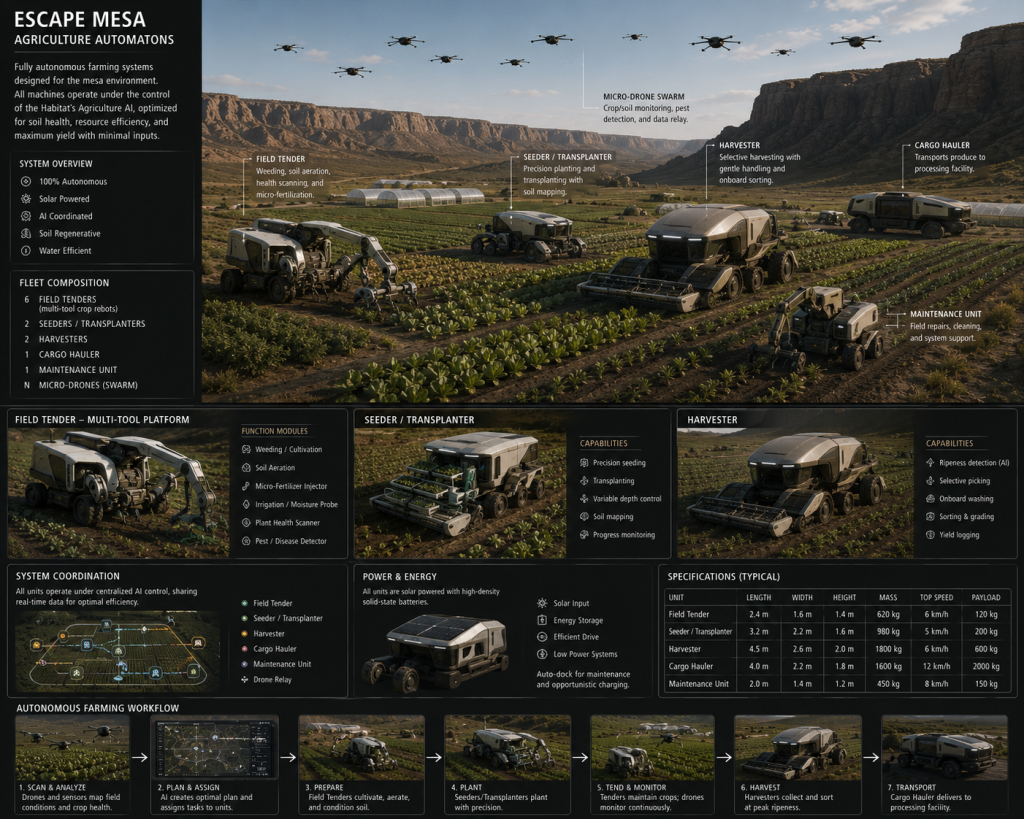
Small autonomous field vehicles move between the growing areas, with different machines handling cultivation, planting, inspection and harvesting. Some are larger machines capable of working across open ground, while others are smaller specialised units designed to work between individual plants where precision matters more than speed. Above them, drones regularly survey the fields and greenhouses, using cameras and sensors to detect changes in plant health that would otherwise be difficult to notice.
They monitor moisture, nutrient levels, pests, disease and changes in plant growth, allowing the system to identify a problem in a particular section without requiring me to walk through the entire crop. If a plant is struggling, the system can determine whether the cause is water, nutrients, disease, insects or something else and respond accordingly, while keeping a record of the problem so that the underlying cause can be investigated.
The farm does not simply grow as much food as possible. It grows what I need, maintains reserves and adjusts planting schedules according to projected consumption, available water and available energy. Some crops grow conventionally in the open fields, while others are cultivated in controlled greenhouses and hydroponic systems where the additional efficiency is worthwhile.
It also grows materials I need rather than food alone, including fibres, oils, seeds and plant material that can be used elsewhere in the biological processing systems. The objective isn’t maximum production; it is resilience, because there is little value in producing an enormous surplus of something I cannot store or use.
From Field to Plate
Harvested food doesn’t simply get dumped into a storage room. It enters another automated system in which the crop is inspected, washed, sorted and processed without requiring me to supervise the operation. Robotic manipulators handle delicate produce, machines prepare ingredients, and other systems dry, freeze, ferment, vacuum-seal or otherwise preserve food according to what makes the most sense for that particular crop.
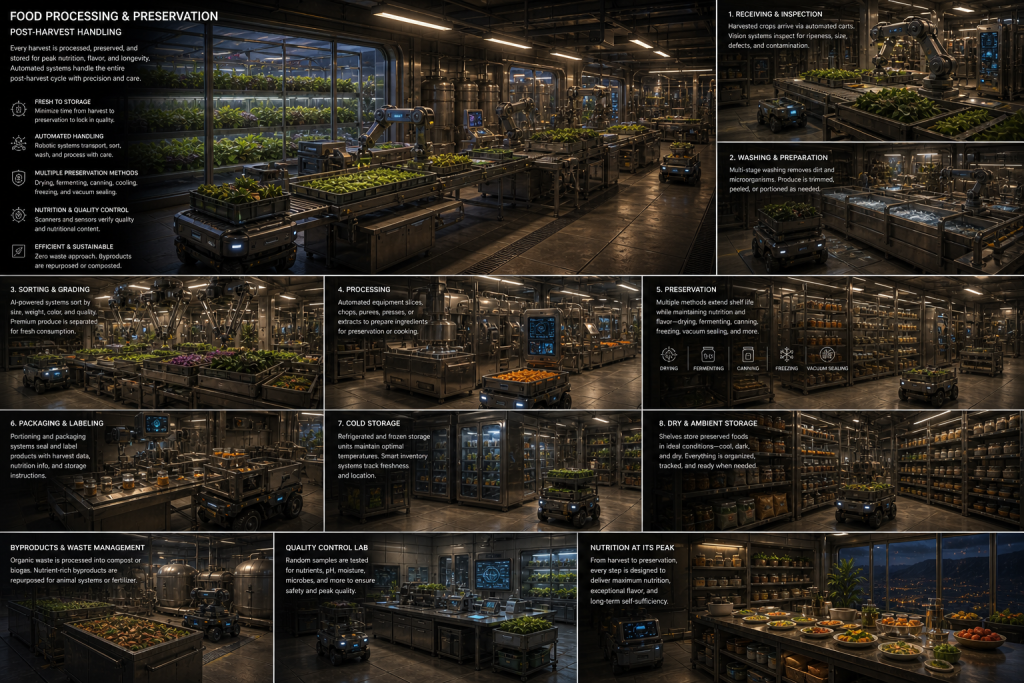
The service block contains cold storage for fresh and frozen supplies, dry storage for preserved food and ingredients, and the equipment required to process crops into forms that will remain useful for months or, where appropriate, years. The system maintains an inventory automatically, tracking what has been harvested, what I have eaten and what is approaching the end of its useful life, and it can then adjust future production so that I am not continually producing food simply to replace food that has been wasted.
There is also enough flexibility to allow me to decide what I actually want to eat. The automated kitchen can prepare a meal without me doing anything, but it does not prevent me from cooking myself when I feel like it. Sometimes I want the convenience of having dinner appear because the system already knows what I normally eat; at other times I want to stand in the kitchen and make something simply because I have nothing else I need to do.
The result is a remarkably boring food supply, and that is exactly what I want. I eat well, I eat a varied and nutritious diet, and I don’t spend my life thinking about where dinner is coming from. There is a certain luxury in making food completely uninteresting.
Power
The mesa is also my power station. Solar panels provide the predictable part of the system, while wind provides another layer, particularly during periods when solar production is poor. The turbines are positioned along the western and northwestern rim, set back from the cliffs and separated from the living area so that the machinery remains largely outside my daily awareness.
I don’t want to see turbines from every window, and I certainly don’t want to hear them. I want them to disappear into the infrastructure, doing their job somewhere on the western horizon while I live on the other side of the mesa. The solar arrays are similarly distributed so that they occupy areas already committed to infrastructure rather than covering the agricultural and natural parts of the plateau unnecessarily.
Energy storage sits beneath the central service areas, along with power-conditioning equipment and the systems that allow generation from different sources to be combined reliably. The control system constantly balances generation, consumption and reserves, making decisions according to both current conditions and what it expects to happen over the next several hours or days.
When energy is plentiful, systems that can use surplus power do so. Water treatment can run ahead, food processing can operate, batteries can charge and thermal systems can store energy. When production falls, unnecessary loads simply disappear or are deferred until conditions improve. The habitat doesn’t need me to remember to turn things off, because the energy-management system already knows which loads matter and which ones can wait.
The result is not a building that consumes as much energy as it can generate. It is a system designed around the assumption that energy availability will change, and that life here should continue comfortably even when the weather does not cooperate.
The Machines
There are no humanoid robots here. I never saw the point.
The machines are tools, and I designed them to look and behave like tools. Some have wheels, some have tracks, some fly, some are fixed robotic arms and others are small maintenance vehicles that spend most of their existence parked beside charging stations. A machine designed to inspect a pipe looks like a machine designed to inspect a pipe; it doesn’t need a face, hands shaped like mine or a simulated personality.
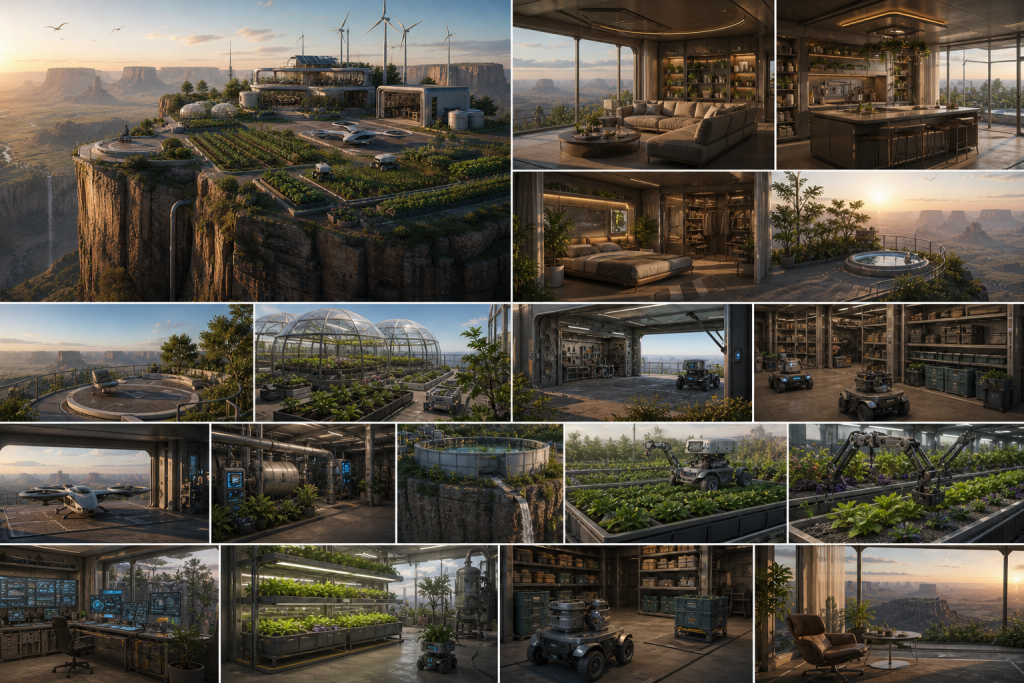
The agricultural machines work outside, while maintenance machines inspect the buildings, turbines, solar arrays, pipes and mechanical systems. Drones inspect the cliffs and the surrounding landscape, and other machines handle cleaning, material movement, internal logistics and routine servicing. The machines are specialised because there is little advantage in asking one complicated general-purpose robot to perform a task that could be handled more reliably by a simple machine designed specifically for it.
The AI systems coordinate everything, although there is no single machine that needs to behave like a human overseer. Different systems are responsible for different areas, with higher-level software coordinating them and maintaining an overall picture of resources, maintenance requirements, weather, agriculture, energy and my own requirements.
The useful part is not that the machines can do everything. It is that they can notice problems before I do. A pump can begin behaving differently from its normal pattern, a bearing can develop a vibration, a battery can show an unexpected change in performance or a greenhouse can begin using more water than expected, and the system can investigate the anomaly while it is still a minor maintenance issue rather than waiting for something to fail completely.
I don’t have a robot servant following me around. I have something considerably more useful: a system that notices that a pump is beginning to fail several weeks before it actually fails.
The Workshop
The workshop is on the southern side of the mesa, beside the landing area, and is deliberately separated from the living complex. This is where machines come when something actually needs repairing, although in practice many repairs are carried out automatically before a component ever reaches the workshop.
The building contains machine tools, additive manufacturing equipment, materials storage, electronics equipment, welding and fabrication systems, diagnostic equipment and the specialised machinery required to maintain the agricultural and energy systems. There are also stocks of critical replacement components, because although many things can be manufactured locally, it makes little sense to fabricate a component from scratch if a spare is already sitting on a shelf.
Most repairs never reach me. A maintenance unit can replace a filter, a robotic arm can replace a component and a fabrication system can produce a replacement part when necessary. If something cannot be repaired automatically, the system isolates it, determines whether the failure affects any other part of the habitat and alerts me with a clear explanation of what has happened and what needs to be done.
I might eventually have to intervene, particularly when something fails in a way the automated systems cannot resolve, but intervention is the exception rather than the daily routine. The workshop is there to make sure that when I do have to intervene, I have the tools, materials and information required to solve the problem rather than having to improvise with whatever happens to be available.
The Flying Machine
The landing pad sits just south of the agricultural area, providing a clear approach and keeping aircraft operations away from the living quarters. The flying machine is stored inside the adjacent hangar, where it can be inspected, maintained and prepared automatically, and the system keeps it ready for use without requiring me to perform the usual sequence of checks that would have been necessary in the world I came from.
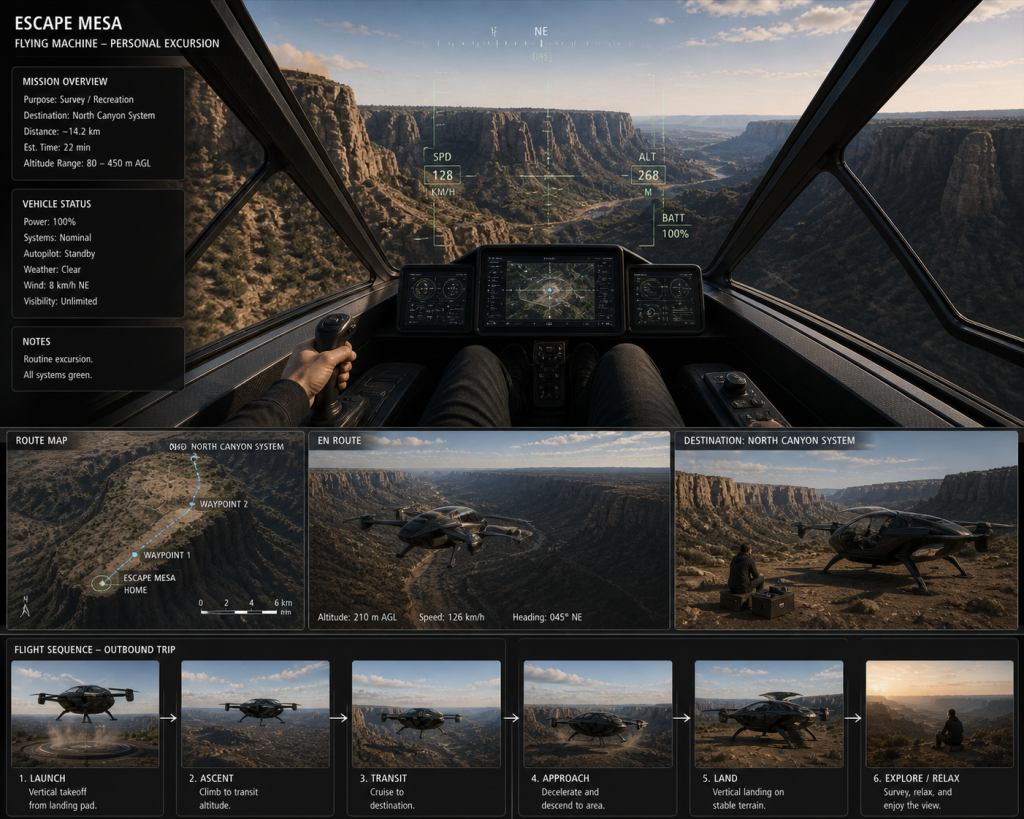
It is another part of the system rather than simply a toy, although I use it for both practical exploration and the less practical pleasure of going somewhere simply because I want to see what is there. There are no airports to worry about, no traffic, no flight schedules and no radio conversations with other pilots, and the surrounding landscape contains no roads or settlements that I need to avoid.
The navigation system knows the terrain, the weather and the machine’s capabilities. I tell it where I want to go, and then I fly. I can let the aircraft handle the navigation while I look at the landscape, or take control myself when I want the experience of flying rather than simply arriving somewhere.
Sometimes I land somewhere distant and sit on the ground for an hour. There is usually no particular objective, and I don’t need one. I can explore a canyon, watch animals moving across the plain or simply sit beside the aircraft and look at a landscape that no human being has ever seen before.
There is a particular freedom in being able to travel through a world that belongs to nobody.
Keeping Myself Alive
The habitat has a gym, although it doesn’t need to be large. There is no reason for it to be filled with equipment designed to impress anyone, because there is nobody here to impress. It contains everything I need to maintain strength, mobility and cardiovascular fitness, with the equipment selected around the requirements of a single person rather than the expectations of a commercial gym.
The system records my exercise and can adjust routines according to how I am performing, but it doesn’t turn exercise into another administrative task. If I want to run, lift weights or use the machines, I can do so; if I decide to go for a long walk around the mesa instead, the system simply records that as part of the overall picture.
The medical facility is similarly compact. Diagnostic equipment continuously monitors the basics, while more sophisticated equipment is available when required, and medical supplies are stored under controlled conditions with automated inventory and replacement planning. The habitat can carry out routine measurements, identify changes that might deserve attention and maintain a detailed record of my health over time.
The system doesn’t make me immortal, and I never designed it on the assumption that technology could remove every risk associated with being alone. What it does is give me a much better chance of noticing a problem early and having the equipment, information and supplies required to deal with it. In a place where there is nobody else to call, that difference matters.
The Weather
The mesa is not a perfectly controlled environment, and I never wanted it to be. I came here to live in the landscape rather than to construct another sealed artificial world, so the weather is allowed to be visible and, to a limited extent, audible.
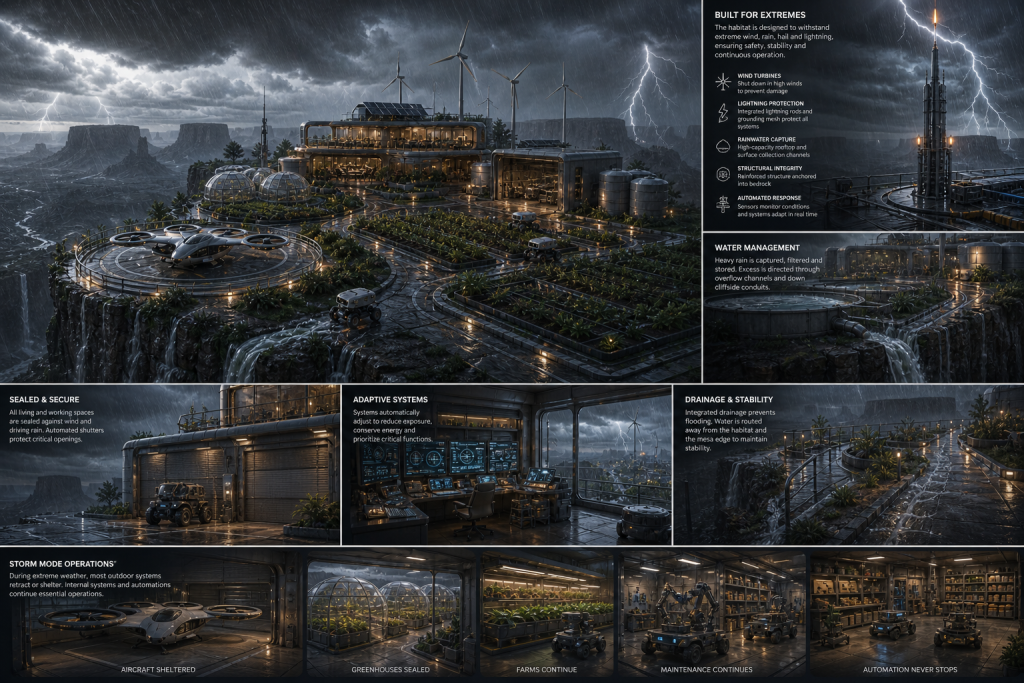
The building is designed to deal with the extremes that the location can produce. The protected western side takes the worst of the prevailing winds, the structure is partly embedded into the mesa and the essential systems are buried or protected behind substantial walls. External machinery is distributed so that a failure in one area does not automatically disable everything else, and the habitat can continue operating at reduced capacity if part of the energy or water system is unavailable.
During ordinary weather I barely notice any of this. The building is simply comfortable, and the view changes around it.
Storms are different. When a major system moves across the region, the western sky darkens and the wind begins to move across the mesa with considerably more force. Rain can arrive almost horizontally, the northern drainage route becomes active and water eventually pours over the cliffs. The turbines work harder, the power-management system changes its priorities and the machines that normally operate outside retreat to protected charging and maintenance areas.
I can sit inside and watch it happen.
The habitat doesn’t need me to fight the storm. It needs to survive it.
Night
At night, the mesa becomes almost completely dark.
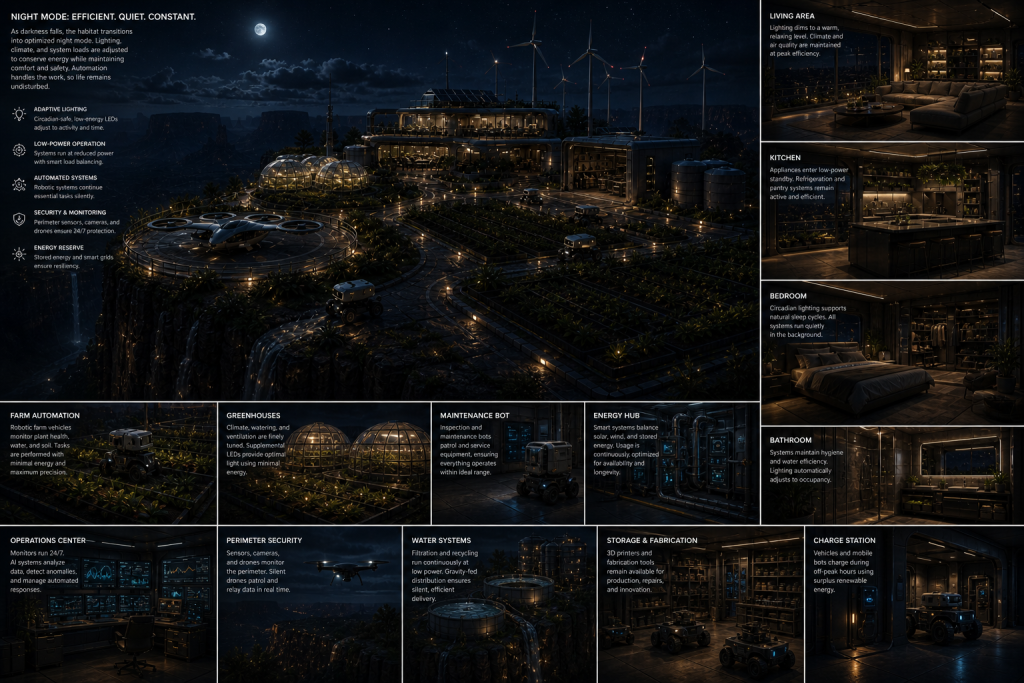
There is no city glow beyond the horizon, no road lighting and no aircraft moving overhead, so when the exterior lights are reduced the darkness is genuine. The habitat itself switches into a low-power night mode, reducing unnecessary lighting and equipment while continuing to operate all of the systems that need to remain active.
Inside, the lighting is soft and deliberately restrained, particularly around the eastern glazing, where reflections would otherwise interfere with the view. Outside, only the lights required for safety and maintenance remain visible, and even those are controlled according to where machines are operating.
On a clear night I can stand on the terrace and see a sky that has not been seen by a human being for millions of years.
There are times when I find myself wondering whether the stars look any different from this distance in time.
Probably not.
It is everything beneath them that has changed.
The Strange Thing About All of This
The remarkable thing isn’t the technology. It is how little of it I notice.
I wake up and the room adjusts itself. The temperature is right, the lights are right, water is available and breakfast is available. The farm is operating, the batteries are charging, the weather system knows what is coming and the maintenance system has already checked the things that would otherwise have required my attention.
The machines are doing their work somewhere beyond the walls, but they don’t follow me around and they don’t constantly announce what they are doing. If everything is functioning normally, I have no reason to think about them at all.
That is perhaps the greatest difference between this place and the technological world I left behind. Modern civilisation often seemed to require constant attention to the technology that was supposed to make life easier. There were passwords to remember, updates to install, devices to charge, accounts to maintain, services to subscribe to and systems that needed troubleshooting precisely when I had something more interesting to do.
Here, technology is infrastructure.
I don’t have to think about the water system every time I turn on a tap, just as I don’t have to think about the electrical grid every time I switch on a light. The difference is that here I am the entire population, so the infrastructure was designed specifically around the needs of one person.
I can spend the morning reading, work on something in the study, exercise, fly or walk around the mesa. I can sit at the eastern edge and watch the sun disappear, or stay inside and spend an evening with a film, a book or a game.
Nothing is demanding my attention.
That was the entire reason for building the place.
Twenty-Five Million Years
Sometimes I wonder what the world would look like if I left the mesa and simply walked. There is plenty of life out there: mammals occupy the plains, birds move across the sky, and forests, grasslands and rivers extend beyond the horizon. The landscape is not empty, and I have no desire for it to be. It is simply a world in which human concerns do not exist.
That distinction is becoming increasingly important to me.
When I look across the landscape, there are no roads to follow, no buildings on the horizon and no signs telling me what a place is called or what it is supposed to become. There are no property boundaries, no construction projects, no traffic and no distant lights marking the presence of a town. The animals have their own territories and patterns, the weather follows its own course, and the landscape has no particular obligation to accommodate me.
I am not trying to become part of that world. I am simply living in it.
That is what I wanted when I came here. I wanted to remove myself from the obligations, expectations and constant activity of human civilisation without having to spend the rest of my life fighting against them. There is nobody asking where I have been, nobody expecting me somewhere else and nobody waiting for me to make a decision on their behalf. If I want to spend a week working on something in the study, I can. If I want to fly somewhere and explore, I can. If I want to do absolutely nothing for an afternoon, there is nothing preventing me from doing that either.
The absence of civilisation is therefore not something I have to endure. It is the condition I came here to achieve.
And after twenty-five million years, the strange thing is that it feels completely normal.
The Point
Escape Mesa was never intended to be a fortress, because it doesn’t need to be. There is no enemy, no competing settlement and no civilisation from which I need to defend myself. The cliffs provide more isolation than any wall could, while the surrounding world is so far removed from my own time that there is effectively nobody who could come looking for me.
It is a machine for making human civilisation unnecessary to one human being.
It produces food, collects and recycles water, generates power, maintains itself, manufactures and repairs what it can, preserves knowledge and provides shelter, exercise, healthcare, entertainment and work. It is not perfectly independent of everything; nothing built by a human being can truly be so, and there are still components, materials and systems whose long-term survival depends on careful planning. But the habitat has been designed with enough redundancy and capability that its useful life can extend far beyond mine.
More importantly, it doesn’t need to grow.
There is no expansion plan, because I don’t need more space. There is no second settlement, because I don’t need another settlement. There is no population strategy and no master plan for colonising the continent. I have no interest in turning the mesa into the beginning of a new civilisation.
There is just the mesa, the machines, the landscape and me.
I wanted somewhere I could disappear, and somewhere that would allow me to remain disappeared without requiring me to spend the rest of my life maintaining the illusion.
I think I succeeded.